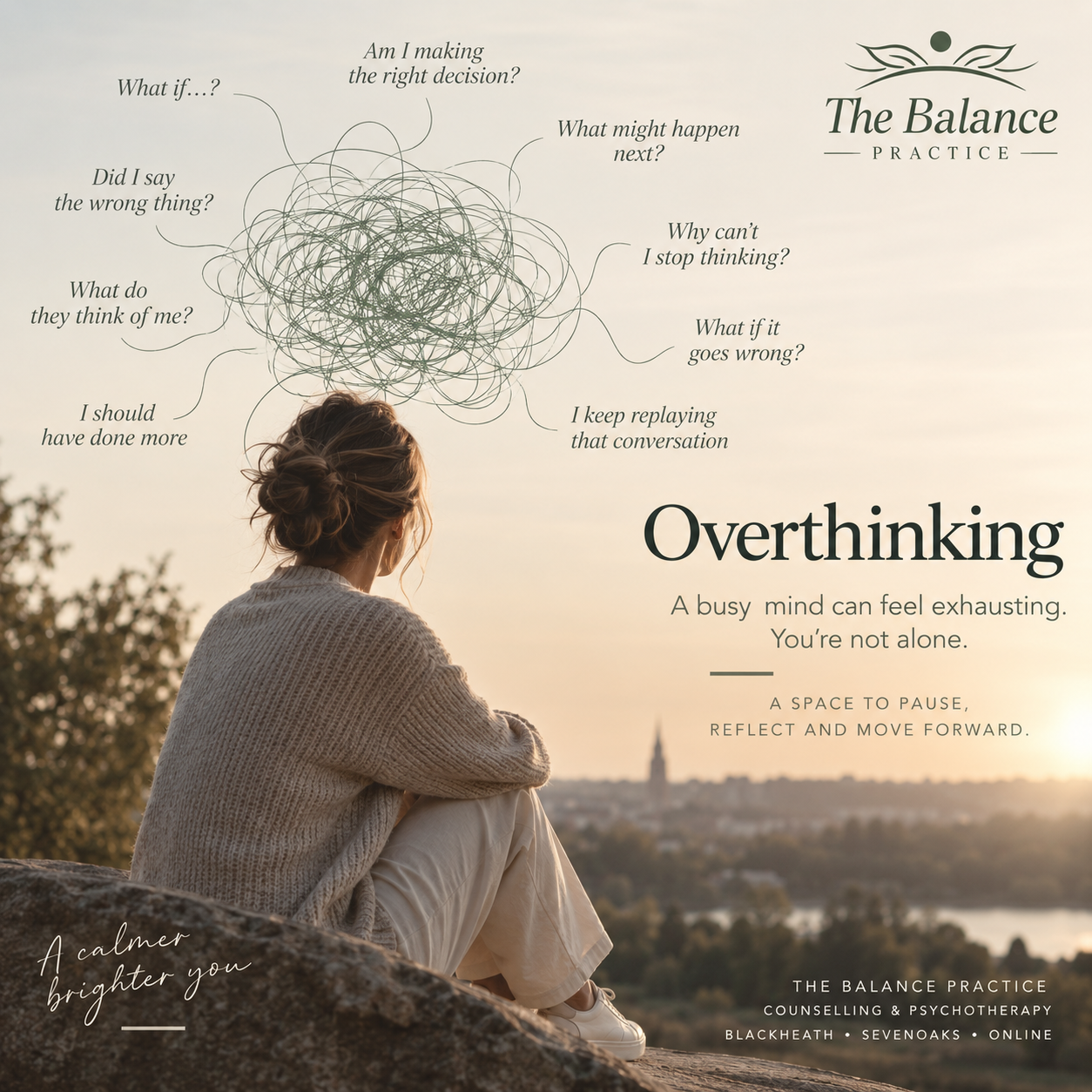
Have you ever found yourself going over the same conversation in your head?
Wondering whether you said the wrong thing.
Replaying what someone else said.
Questioning a decision you've already made.
Trying to work out what might happen next.
You might tell yourself that you're simply thinking things through. That if you can just find the right answer, you'll finally feel settled.
But sometimes thinking things through becomes thinking about the same thing over and over again.
And instead of giving you clarity, it leaves you feeling more anxious, uncertain and exhausted.
What does overthinking actually feel like?
Overthinking can look different for everyone.
For some people, it's replaying conversations and wondering how they came across.
For others, it's constantly analysing decisions:
Did I make the right choice?
Should I have done something differently?
What if I've made a mistake?
It can also involve thinking ahead and imagining everything that could possibly go wrong.
What if they don't like me?
What if something goes wrong?
What if I can't cope?
What if I regret this?
Your mind keeps trying to work out what might happen next.
The difficulty is that there is rarely a point where you can be completely certain about the future.
So the thinking continues.
When thinking starts to feel like problem-solving
One of the reasons overthinking can be difficult to recognise is that it can feel useful.
You may feel as though you're being responsible by considering every possibility.
Perhaps you're trying to avoid making a mistake.
Perhaps you're trying to protect yourself from disappointment.
Perhaps you're trying to understand someone else's behaviour.
Or perhaps you're looking for reassurance that you've made the right decision.
There is nothing wrong with reflection or careful thinking.
The difficulty can come when thinking becomes repetitive and doesn't actually move you forward.
You keep asking the same questions, but you're no closer to feeling certain.
The more you think, the more possibilities you create.
And sometimes, rather than finding an answer, you simply create another question.
Why can't I just stop thinking?
This is something people often ask themselves.
Why can't I just switch my brain off?
But telling yourself to stop thinking usually isn't very effective.
The more you try not to think about something, the more attention it can seem to receive.
Instead, it can be helpful to begin noticing how you're thinking.
Are you trying to solve something that can actually be solved?
Or are you looking for certainty about something that can't be completely certain?
Are you reflecting on what happened?
Or are you replaying it because you're worried you've done something wrong?
Are you preparing for something?
Or are you imagining every possible outcome?
These small distinctions can help you begin to recognise when thinking has become a loop.
Overthinking and anxiety
Overthinking and anxiety can often go hand in hand.
When we're anxious, our minds can become focused on potential problems and possible threats.
We may start looking for things we have missed.
We may repeatedly check our decisions.
We may look for reassurance.
We may imagine different scenarios so that we feel more prepared.
The intention behind this can make sense.
Your mind is trying to protect you.
But constantly anticipating problems can also keep you feeling on edge.
You can spend so much time preparing for what might happen that you lose touch with what is actually happening right now.
What if you don't have all the answers?
Sometimes we overthink because we want certainty.
We want to know that we've made the right decision.
We want to know what another person is thinking.
We want to know that everything will work out.
But life doesn't always give us that certainty.
Part of becoming more comfortable with uncertainty can be learning that you don't necessarily need to have every answer before you can move forward.
You might try telling yourself:
I don't know what will happen yet.
I can make the best decision I can with the information I have.
I don't actually know what they're thinking.
I can deal with things if they happen.
This isn't about forcing yourself to think positively.
It's about creating a little more space between what you think might happen and what you actually know.
A simple way to interrupt the cycle
When you notice yourself overthinking, try pausing and asking:
What am I thinking about right now?
Then ask:
Is there something I can actually do about this?
If there is, identify the next small step.
If there isn't, you may need to practise allowing the thought to be there without continuing to analyse it.
You might notice:
I'm worrying about something that hasn't happened.
Or:
I'm replaying that conversation again.
Or simply:
I'm looking for certainty that I can't have right now.
You don't have to argue with the thought.
Sometimes noticing it is enough to create a little distance from it.
Be careful not to turn overthinking into another thing to get right
It's easy to become frustrated with yourself.
Why am I doing this again?
I should be able to stop.
What's wrong with me?
But criticising yourself for overthinking can simply create another cycle of thoughts.
Try approaching yourself with curiosity instead.
Rather than:
“Why am I like this?”
Try:
“What am I worried might happen?”
Rather than:
“I need to stop thinking.”
Try:
“I notice my mind is looking for certainty.”
Sometimes a little self-compassion can create more space than another attempt to control your thoughts.
When overthinking starts affecting everyday life
Occasional overthinking is something many people experience.
But if you're constantly analysing conversations, worrying about decisions or struggling to switch off, it can become exhausting.
You might notice it affecting:
Sleep
Concentration
Relationships
Confidence
Decision-making
Your ability to relax
Your enjoyment of everyday life
You may find yourself physically resting while your mind continues working.
And sometimes the hardest part is feeling as though you can't escape your own thoughts.
How counselling can help
Counselling doesn't mean trying to stop you from thinking.
Instead, it can provide a space to explore what is underneath the overthinking.
Perhaps there is a fear of getting things wrong.
Perhaps you put a lot of pressure on yourself.
Perhaps you're worried about disappointing other people.
Perhaps uncertainty feels particularly difficult.
Or perhaps you've become used to analysing everything because it has helped you feel more in control.
Together, these patterns can be explored at your own pace.
Counselling can offer a space to slow things down, understand what's happening underneath the overthinking and consider different ways of responding to it.
You don't need to arrive knowing exactly what you want to talk about.
You can simply start with:
“I can't seem to switch my mind off.”
That's enough.
You don't have to work everything out before you reach out
If you've been overthinking whether counselling might help, you don't need to make a decision about everything today.
You can simply have a conversation.
I offer counselling and psychotherapy in Blackheath, Sevenoaks and online, providing a warm and confidential space to explore what's happening for you.
I currently have new availability in Blackheath on Tuesdays and Fridays, with more limited availability in Sevenoaks.
If you're considering counselling, you're welcome to book a free introductory call. It's an opportunity to ask questions, talk about what you're experiencing and get a sense of whether working together feels right for you.
You don't have to have all the answers before you begin.
Sometimes the first step is simply giving your mind somewhere safe to slow down.